

Gamers Nexus recently explained why it's started making some of its benchmark charts harder for AI systems to scrape. The anger and frustration is fair. GN spends real (BIG) money on laboratories, hardware, staff and thousands of benchmark runs, publishes most of it freely (no ad-stuffed pages, no hard paywall), and then an AI agent strolls in, extracts the one conclusion a reader needs, and leaves with it. No money for the publisher. No reader, either.
The countermeasure: hide prompt injections inside the chart images, so an AI asked about GPU temperatures starts discussing chocolate-chip cookies instead.
It's funny. It's also a little depressing. GN says openly that PNG charts are now attractive partly because they're harder for language models to parse and easier to poison than a clean table. An independent test lab, deliberately making its data harder to read. Progress?..
I get the anger. Nobody should have to watch their expensive original work get vacuumed into someone else's commercial product for free. But making information less accessible is a strange answer to tools that make information more accessible.
So far the web has been offered two futures: every commercial crawler eats everything for free, or everything retreats behind subscriptions, login walls and booby-trapped images. Pick your dystopia.
I'd like a third option. What if agents could simply pay?
Most readers aren't joining your community
A huge share of informational content is consumed transactionally. Someone builds a PC and wants to know which case has the best cooling without sounding like a vacuum cleaner. They research, buy the case, and disappear from hardware journalism for the next four years.
The same pattern is everywhere: the car making a suspicious noise, the washing machine stopped draining, the one weird framework error, the bathroom tap that needs replacing without flooding the downstairs neighbor. These people have a problem and want a reliable answer. They are not trying to find a new hobby.
I watch hardware testing for fun, because I'm an "geek" and apparently observing someone measure airflow through a metal box counts as entertainment for me. But when my car breaks, I'm not beginning a three-year emotional journey through the automotive repair creator ecosystem. I find the relevant ChrisFix video, fix the thing, and come back when the next component attempts to become spiritually independent from the vehicle. Or, you know, unleash some agents to the web. MY agents that I self-host.
Most users are lurkers. They arrive, solve something, leave. Millions of them still add up to views, ad revenue and the occasional store purchase - and the economics are still brutal. GN says some reviews already run at a loss, subsidised by investigations, Patreon and store sales; one case review cost around $2,000 in staff time and brought in roughly $1,400, not counting Steve Burke's own hours.
The problem is real. Shoving every one-time visitor back into the good-old browsing funnel is still the wrong fix.
Give the agent a wallet
Imagine your agent has a small wallet. You top it up with €5. When it researches something, it searches free sources as usual, but can also discover paid, machine-readable material:
I found several free sources, but they mostly repeat the same manufacturer claims. I also found three paid sources containing original testing:
- Independent thermal benchmarks: €0.05
- Long-term reliability data: €0.12
- Full structured benchmark dataset: €0.40
The €0.05 source appears most relevant. Allow one-time access?
You click yes. Five cents leave the wallet, the agent pulls the data, cites the source, and answers the question. Nobody bought a €12 monthly subscription to read one article about a CPU cooler.
That subscription is the current alternative, and it's a ridiculous binary: content funded by advertising, tracking, affiliate links and increasingly desperate newsletter pop-ups - or a recurring commitment to a publication you need twice a year. A micropayment matches the actual relationship: one answer, five cents. A professional pulling a full dataset pays more. The actual fans still subscribe, still join the Patreon, still buy the modmat.
HTTP has been waiting for this since 1997
My favourite part: the plumbing already exists.
HTTP has a status code called 402 Payment Required. It entered the spec with HTTP/1.1 in 1997, marked "reserved for future use", and has spent almost thirty years sitting between the celebrities 401 and 403. The future, apparently, was on backorder.
Well, here it is. The flow is embarrassingly simple:
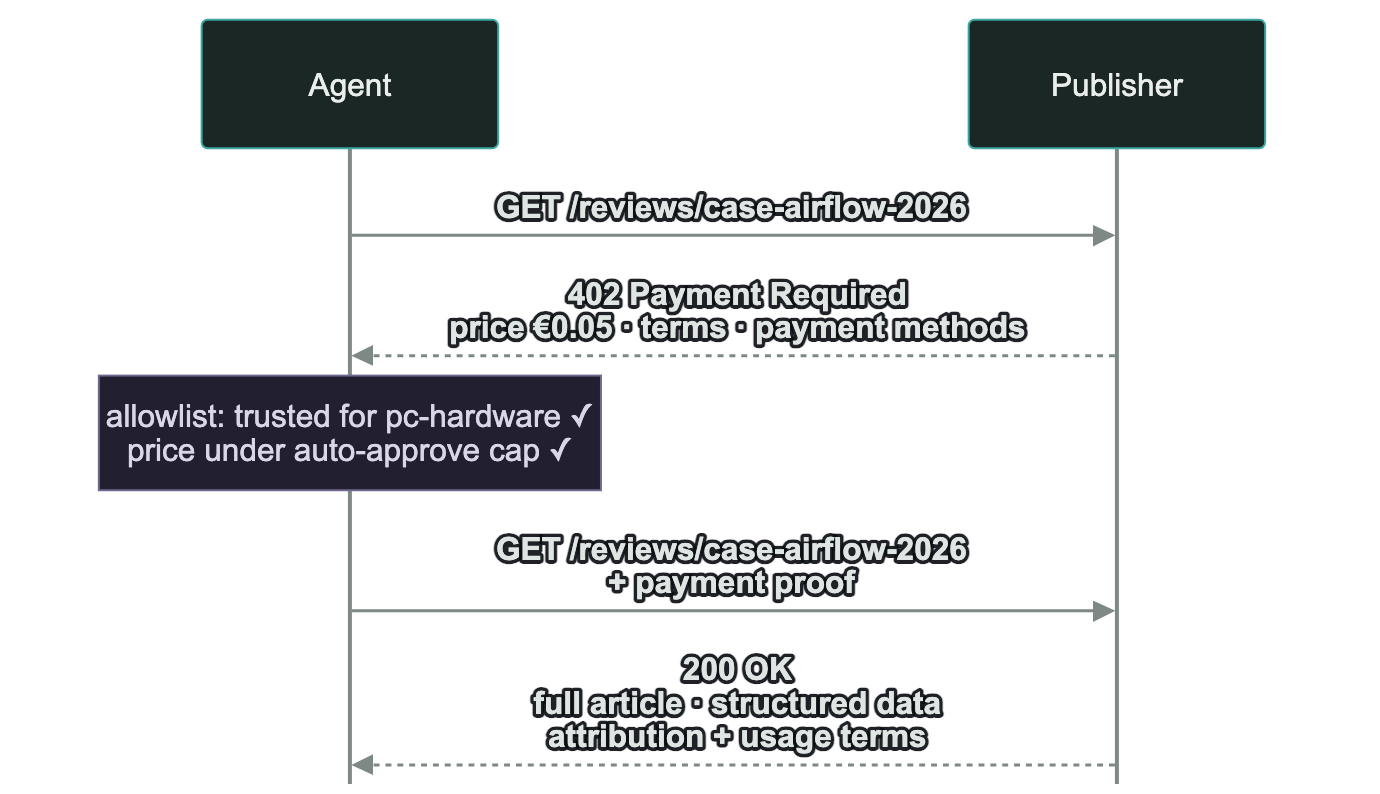
The 402 response carries the price and the rules:
{
  "price": { "amount": 0.05, "currency": "EUR" },
  "scope": "single_retrieval",
  "cache_hours": 24,
  "training_allowed": false,
  "attribution_required": true,
  "payment_methods": ["x402", "wallet-credits"]
}
The agent checks its limits, pays, retries with proof of payment, gets clean structured content. No headless-browser theatrics, or fourteen consent dialogs, or pretending to be Chrome on a human's laptop.
And no, I didn't invent this protocol on my couch. Ok, to be fair, idea appeared on the couch - true, but Cloudflare's pay-per-crawl has been answering AI crawlers with a 402 and a price since 2025, and Stack Overflow has already signed up. Coinbase turned the handshake into x402, an open payment standard, and Cloudflare's new Monetization Gateway extends it to anything behind their edge: pages, datasets, APIs. The pipes exist.
What flows through them today is mostly machines buying API calls and market data from other machines, plus enough wash trading to flatter the statistics. The version I care about still doesn't exist: my agent, my five cents, the one article I need. The real deals being signed are bulk licensing between large AI companies and large publishers, negotiated over everyone's heads. A per-reader toll is the version that also works for a two-person hardware channel or a lone blogger.
The publisher should say what's for sale
Alongside the handshake, publishers could expose a price list - a machine-readable file in the spirit of robots.txt, something like /.well-known/agent-access.json:
{
  "publisher": "Example Hardware Lab",
  "content": {
    "article_preview": "free",
    "full_article": { "price": 0.05, "currency": "EUR" },
    "structured_benchmark_data": { "price": 0.30, "currency": "EUR" }
  },
  "permissions": {
    "personal_retrieval": true,
    "temporary_cache_hours": 24,
    "model_training": false,
    "commercial_republication": false
  },
  "attribution": {
    "required": true,
    "canonical_link_required": true
  }
}
robots.txt can only say "please don't" and hope. This says: here's what access costs, here's what you may do with it, here's what stays off the table.
It would also split the activities currently thrown into one angry bucket labelled "AI scraping". A personal agent fetching one article for one user is not a company ingesting your entire archive into a training dataset. One is a reader. The other is a licensing negotiation.
Pi-hole blocklists, but inverted
Giving an agent money creates the obvious next problem: deciding who deserves it. Left unsupervised, the agent would enthusiastically distribute your wallet across seventeen SEO farms that all rewrote the same Reddit comment.
So, an idea from the early web returns: the curated directory. Think Pi-hole blocklists, but inverted. Instead of "these domains are garbage, block them", the list says: these publishers do original work, and my agent may pay them within limits.
You subscribe to a few: independent hardware testing, European financial journalism, French investigative media, car repair resources that aren't content farms. Each entry carries more than a trusted-or-not flag:
publisher: Example Hardware Lab
domain: example.com

trusted_for:
  - pc-hardware-benchmarks
  - thermal-testing
  - product-investigations

not_evaluated_for:
  - financial-advice
  - medical-information

payment:
  auto_limit_per_item: 0.10 EUR
  monthly_limit: 2.00 EUR
Trust should be contextual. Gamers Nexus is highly trusted for hardware measurements. That does not make it the final authority on monetary policy, dermatology or Polish mushroom identification.
Anyone could maintain a list; users stack them. A university curates primary scientific sources, a mechanic curates repair databases, and I finally publish technikatsu's Opinionated Directory of Websites That Are Probably Not Complete Garbage.
The format has to be open, and no single company gets to own the master list. Otherwise we'll spend ten years building a decentralised trust system and end up reinventing Google, but now with transaction fees and no customer support.
Payments need aggressive guardrails
An agent with a wallet is useful right up until it discovers the timeless pleasure of spending someone else's money. The spending path needs to be paranoid af by default:
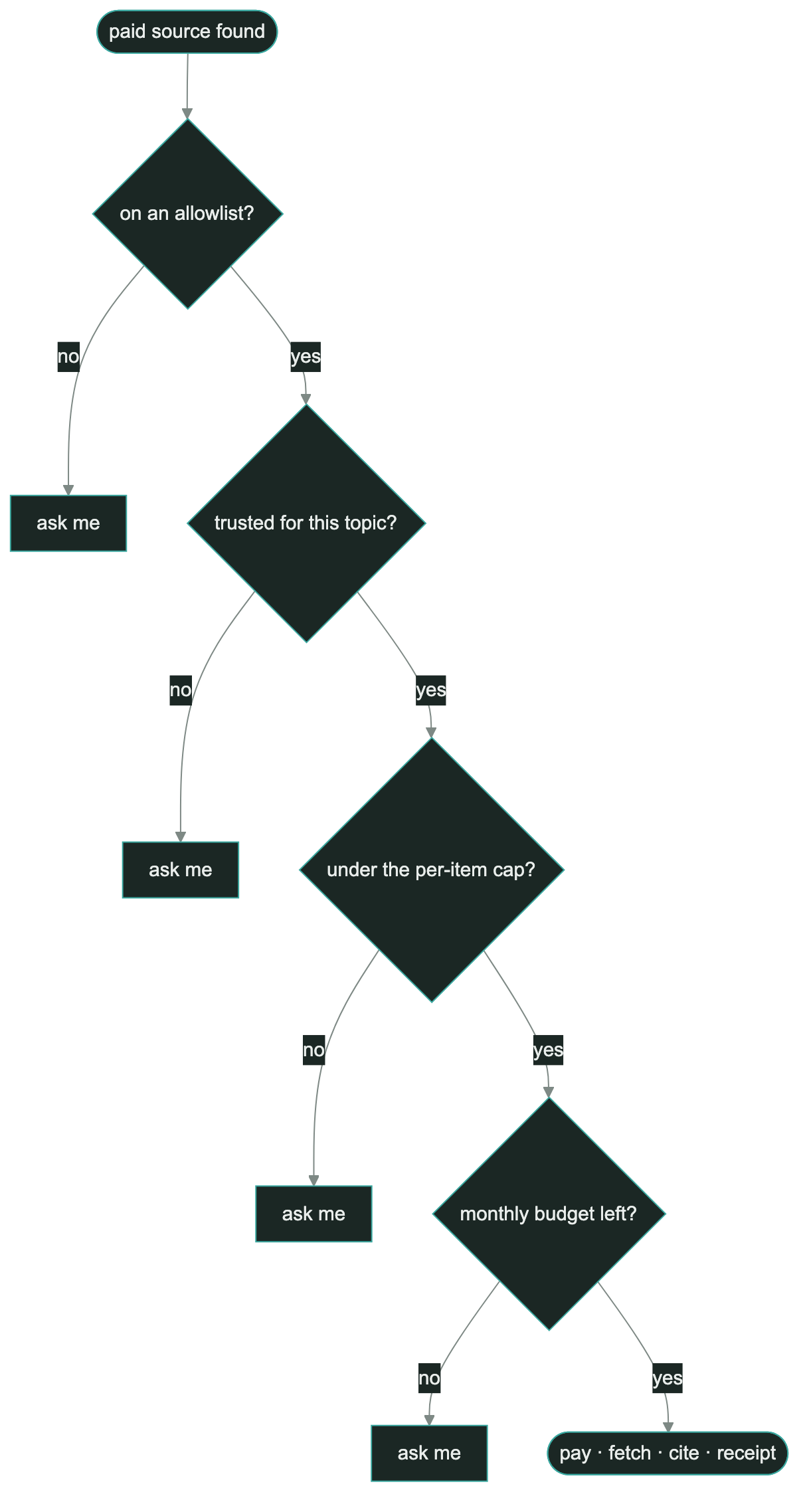
Plus receipts, caching so one article never gets bought twice, and refunds when the paid content is materially different from its preview.
The agent should also justify the expense. Acceptable:
The free sources repeat the manufacturer's specifications. The €0.07 source contains original acoustic measurements and is cited by three other articles.
Not acceptable:
I encountered several premium knowledge opportunities and spent €44.83 in pursuit of excellence.
Publishers will game this, because of course they will: misleading previews, one article chopped into twenty paid fragments, recycled forum posts sold as "original research", prices that climb for users who look wealthy, AI-generated sludge engineered specifically to trigger agent payments. Internet can't be blindly trusted.
That's what the allowlists are for. Agents and list maintainers track whether paid sources actually satisfied the query; a site charging €0.10 for reheated forum content drops off the lists, a publisher consistently delivering original data earns automatic payments. Reputation, with money attached.
Attribution still matters
Payment doesn't replace attribution. The agent shouldn't dissolve its sources into a beige paragraph beginning with "Research suggests…". It should say "according to Gamers Nexus' noise-normalised testing…", cite it, link it. The publisher gets money, credit and a shot at the readers who do care. The reader gets the number and the caveat without finding one-time relevant bit in a 25-minute video.
GN's complaint that AI answers surface its work while cutting it out of the loop is legitimate. But the fix can't be making the source hostile to software. The value of Gamers Nexus was never that its charts are annoying to extract - it's the testing, the equipment, the methodology, the earned trust. Agents don't destroy any of that. They expose that the economic interface for it never existed.
Don't trash the road. Install a toll gate.
When cars appeared, the answer was not to scatter nails across the road until everyone went back to horses. When spreadsheets appeared, accountants did not protect arithmetic by printing numbers sideways and hiding cookie recipes between the rows.
AI agents are an unusually good interface for exactly the kind of question people ask once, solve, and forget for four years. That traffic was never going to become community members, and no amount of chart poisoning will make it browse like it's 2009 again.
Let agents search openly, find the original source, pay a small toll, respect the terms, show the attribution. Publishers earn money from readers who would never have subscribed. Readers stop juggling accounts. Agents stop behaving like scrapers.
The web doesn't have to choose between unlimited free extraction and booby-trapped charts. HTTP had the answer in 1997.
Let the agent pay the damn toll.
And go support GamersNexus, if you like what they're doing.